"Ward-off is on both arms,
roll-back is on the palm,
press is on the back of the hand
push is on the waist
pluck is on the ten fingers,
split is on both forearms,
elbow strike is used bent,
shoulder strike is on the shoulders and chest,
advance is on move hands like clouds,
retreat is on turning the forearms,
look after is one third in the front,
expect is on the seven stars,
steadiness is on the gaps,
the center needs to be horizontal,
stagnation is on double-weight,
connecting is on single lightness,
insubstantial is on defence,
substantial is on move forward."
Based on the translation by Yang Jwing Ming (楊俊敏) presented in the book Tai Chi Secrets of the Yang Style (太極拳楊氏先哲秘要)
Sunday, April 11, 2010
Monday, April 5, 2010
The Secret of Eighteen Dependencies (十八在訣) by Yáng Bānhóu (楊班侯)
十八在訣
掤在兩臂,履在掌中,
擠在手背,按在腰攻,
採在十指,挒在兩肱,
肘在曲使,靠在肩胸,
進在雲手,退在轉肱,
顧在三前,盼在七星,
定在有隙,中在得橫,
滯在雙重,通在單輕,
虛在當守,實在必沖。
掤在兩臂,履在掌中,
擠在手背,按在腰攻,
採在十指,挒在兩肱,
肘在曲使,靠在肩胸,
進在雲手,退在轉肱,
顧在三前,盼在七星,
定在有隙,中在得橫,
滯在雙重,通在單輕,
虛在當守,實在必沖。
Friday, March 26, 2010
The Secret of Yin Yang (陰陽訣) by Yáng Bānhóu (楊班侯)
陰陽訣
太極陰陽少人修,吞吐開合問剛柔。
正隅收放任君走,動靜變化何須愁。
生克二發隨招用,閃進全在動中求。
輕重虛實怎的是,重里現輕勿稍留。
太極陰陽少人修,吞吐開合問剛柔。
正隅收放任君走,動靜變化何須愁。
生克二發隨招用,閃進全在動中求。
輕重虛實怎的是,重里現輕勿稍留。
"There are few people that study Tai Chi's Yin Yang. It asks for hardness and softness, to take in and send out, to open and to close.
Accepting the directions and the corners allow you to move as you wish, there is no need to worry about changes in the movement.
Producing and collecting both are used in the maneuvers of sending out and following. Both dodging and advancing can be found inside the movements.
Lightness and heaviness are within the substantial and insubstantial, do not hesitate to show lightness within heaviness."
Based on the translation by Yang Jwing Ming (楊俊敏) presented in the book Tai Chi Secrets of the Yang Style (太極拳楊氏先哲秘要)
Accepting the directions and the corners allow you to move as you wish, there is no need to worry about changes in the movement.
Producing and collecting both are used in the maneuvers of sending out and following. Both dodging and advancing can be found inside the movements.
Lightness and heaviness are within the substantial and insubstantial, do not hesitate to show lightness within heaviness."
Based on the translation by Yang Jwing Ming (楊俊敏) presented in the book Tai Chi Secrets of the Yang Style (太極拳楊氏先哲秘要)
Sunday, March 21, 2010
Saturday, March 20, 2010
The Secret of Insubstantial and Substantial (虛實訣) by Yáng Bānhóu (楊班侯)
虛實訣
虛虛實實神會中,虛實實虛手行功。
練拳不諳虛實理,枉費功夫終無成。
虛守實發掌中竅,中實不發藝難精。
虛實自有虛實在,實實虛虛攻不空。
虛虛實實神會中,虛實實虛手行功。
練拳不諳虛實理,枉費功夫終無成。
虛守實發掌中竅,中實不發藝難精。
虛實自有虛實在,實實虛虛攻不空。
"What is substantial and what is insubstantial are gathered within the spirit, the differentiation of the substantial and insubstantial is the achievement of the hand.
To practice boxing without understanding the essence of the difference between substantial and insubstantial is to waste one's effort to achieve nothing at the end.
Defend with the insubstantial, attack with the substantial, the trick is within the palms. If one stays substantial in the center, there is no send-out skill and the energy is distressed.
Insubstantial and substantial have a concrete reason, with the differentiation of insubstantial and substantial, attacking will not be in vain."
Based on the translation by Yang Jwing Ming (楊俊敏) presented in the book Tai Chi Secrets of the Yang Style (太極拳楊氏先哲秘要)
To practice boxing without understanding the essence of the difference between substantial and insubstantial is to waste one's effort to achieve nothing at the end.
Defend with the insubstantial, attack with the substantial, the trick is within the palms. If one stays substantial in the center, there is no send-out skill and the energy is distressed.
Insubstantial and substantial have a concrete reason, with the differentiation of insubstantial and substantial, attacking will not be in vain."
Based on the translation by Yang Jwing Ming (楊俊敏) presented in the book Tai Chi Secrets of the Yang Style (太極拳楊氏先哲秘要)
Tuesday, March 16, 2010
Sunday, March 14, 2010
The Song of True Meaning of Tàijíquán (太極拳真義訣) by Lǐ Dàozi (李道子)
One of the difficulties one may encounter when looking at the texts presented as important for the practice is their cryptic language. It can be understood that some of the inner experiences can only be passed on in poetic form. It is also understood that early texts come from oral traditions tend to come in "songs" or texts that are easier to memorize.
For example, this text has the suggestive name of "The Song of True Meaning of Tai Chi Chuan". It certainly attracts attention also because it is reported by two important authors like Yang Jwing Ming (楊俊敏) and Jou Tsung Hwa (周宗樺). So, definetely something that the serious practicant should pay attention to.
In the other hand, beyond the evocations it brings, it is difficult to have an indication of how it should influence our practices. At least, if it is not commented by the practice with a recognized Master.
For example, this text has the suggestive name of "The Song of True Meaning of Tai Chi Chuan". It certainly attracts attention also because it is reported by two important authors like Yang Jwing Ming (楊俊敏) and Jou Tsung Hwa (周宗樺). So, definetely something that the serious practicant should pay attention to.
In the other hand, beyond the evocations it brings, it is difficult to have an indication of how it should influence our practices. At least, if it is not commented by the practice with a recognized Master.
太極拳真義訣
無形無象,全身透空。
忘物自然,西山懸磬。
虎吼猿鳴,泉清水靜。
翻江鬧海,盡性立命。
無形無象,全身透空。
忘物自然,西山懸磬。
虎吼猿鳴,泉清水靜。
翻江鬧海,盡性立命。
"No shape, no shadow.
The entire body is transparent as air.
Forget your surroundings and be natural.
Like a stone chime suspended from the West Mountain.
Tigers roaring, monkeys screeching.
Clear fountain, peaceful water.
Turbulent river, stormy ocean.
Develop your whole body and mind to their full extent."
From the book The Tao of Tai Chi Chuan" (太極拳之道), by Jou Tsung Hwa (周宗樺) and "Yang Style Tai Chi Chuan" by Yang Jwing Ming (楊俊敏) based on the translations proposed in both books.
The entire body is transparent as air.
Forget your surroundings and be natural.
Like a stone chime suspended from the West Mountain.
Tigers roaring, monkeys screeching.
Clear fountain, peaceful water.
Turbulent river, stormy ocean.
Develop your whole body and mind to their full extent."
From the book The Tao of Tai Chi Chuan" (太極拳之道), by Jou Tsung Hwa (周宗樺) and "Yang Style Tai Chi Chuan" by Yang Jwing Ming (楊俊敏) based on the translations proposed in both books.
Saturday, February 27, 2010
Journal of Asian Martial Arts
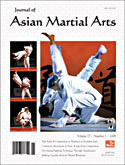
The Journal of Asian Martial Arts is probably the only magazine that I could add within my references of study, along with the Pa Kua Journal. Far from the screaming pictures of martial arts magazines, it has a serious and scholar style.
There are really two types of articles. The first one is the kind that link martial arts with its context, historical, artistic, cultural, religious. These articles imply field research and academic insight. They are by far the most interesting, as they throw some light on aspects that would otherwise remain unperceived.
The second kind of article is the more common kind centered around techniques. They have the merit of being sober and presenting little known schools or aspects. In the other hand, they do not differ much from the more common technical manual.
One of the sections of the magazine is of particular interest: the book reviews are well done and do present very relevant critiques.
There are really two types of articles. The first one is the kind that link martial arts with its context, historical, artistic, cultural, religious. These articles imply field research and academic insight. They are by far the most interesting, as they throw some light on aspects that would otherwise remain unperceived.
The second kind of article is the more common kind centered around techniques. They have the merit of being sober and presenting little known schools or aspects. In the other hand, they do not differ much from the more common technical manual.
One of the sections of the magazine is of particular interest: the book reviews are well done and do present very relevant critiques.
Saturday, February 13, 2010
Stretch (挺) from the Xingyi Eight Characters Secret (形意八字訣)
挺
有三挺,即
一。頸項挺,則頭部正直,精氣貫頂。
二。脊骨腰挺,則力達四稍,氣鼓全身。
三。膝蓋挺,則氣恬神怡,如樹生根。
是謂之三挺。
有三挺,即
一。頸項挺,則頭部正直,精氣貫頂。
二。脊骨腰挺,則力達四稍,氣鼓全身。
三。膝蓋挺,則氣恬神怡,如樹生根。
是謂之三挺。
"Stretch. The three things that must be stretched:
a) When the neck stretches, the head is straight and the jing and chi can reach the top.
b) When the spine is stretched, the force reaches the four limbs and the chi permeates the whole body.
c) When the knees stretch (out), the qi is calm and the spirit is in harmony, like a tree with strong roots.
These are the three stretches."
From the book Xingyi Connected Fist (形意連環拳), by Lǐ Cúnyì (李存義), and from Xingyi Mother Fists (形意母拳) by Jiāng Róngqiáo (薑容樵) based on the translations by Joseph Crandall
a) When the neck stretches, the head is straight and the jing and chi can reach the top.
b) When the spine is stretched, the force reaches the four limbs and the chi permeates the whole body.
c) When the knees stretch (out), the qi is calm and the spirit is in harmony, like a tree with strong roots.
These are the three stretches."
From the book Xingyi Connected Fist (形意連環拳), by Lǐ Cúnyì (李存義), and from Xingyi Mother Fists (形意母拳) by Jiāng Róngqiáo (薑容樵) based on the translations by Joseph Crandall
Wednesday, February 3, 2010
Bend (曲) from the Xingyi Eight Characters Secret (形意八字訣)
曲
有三曲,即
一。兩臂要曲弓如半月,則力富。
二。兩膝宜曲,彎如半月,則力厚。
三。手腕宜曲,曲如半月,則力湊。
皆取其伸縮自如,用勁不斷之意。
是謂之三曲。
有三曲,即
一。兩臂要曲弓如半月,則力富。
二。兩膝宜曲,彎如半月,則力厚。
三。手腕宜曲,曲如半月,則力湊。
皆取其伸縮自如,用勁不斷之意。
是謂之三曲。
"Bend. The three things that one must be bent:
a) Both arms ought to be bent, like a half-moon, the strength is abundant.
b) Both knees ought to be bent, like a half-moon, the strength is deep.
c) Both wrists ought to be bent, like a half-moon, the strength comes together.
All of them gets its natural extension and contraction, the strength of the intention unbroken.
These are the three things that must be bent."
From the book Xingyi Connected Fist (形意連環拳), by Lǐ Cúnyì (李存義), and from Xingyi Mother Fists (形意母拳) by Jiāng Róngqiáo (薑容樵) based on the translations by Joseph Crandall
a) Both arms ought to be bent, like a half-moon, the strength is abundant.
b) Both knees ought to be bent, like a half-moon, the strength is deep.
c) Both wrists ought to be bent, like a half-moon, the strength comes together.
All of them gets its natural extension and contraction, the strength of the intention unbroken.
These are the three things that must be bent."
From the book Xingyi Connected Fist (形意連環拳), by Lǐ Cúnyì (李存義), and from Xingyi Mother Fists (形意母拳) by Jiāng Róngqiáo (薑容樵) based on the translations by Joseph Crandall
Subscribe to:
Posts (Atom)