Wednesday, August 12, 2015

Excerpt from the Great Learning (大學) in the Analects (論語)Trecho do Grande Aprendizado (大學) dos Analetos (論語)

「茍日新,日日新,又日新。」

孔子
"'If you can one day renovate yourself, do so from day to day. Yea, let there be daily renovation.'"

Unless noted otherwise, all quotations of classical texts and accompanying translations come from the Chinese Text Project
"'Se alguém pode se renovar, ele de fazê-lo um dia apos o outro. Que haja renovação todo dia.'"

Traduzido à partir da tradução para o inglês do Chinese Text Project

Friday, August 7, 2015

Unification (一) from The Essentials of Yue Fei's Boxing Art (附岳武穆形意拳術要論)

第一章 一、要論

從來散之必有其統也,分之必有其合也,以故天壤間四面八方,紛紛者各有所屬,千頭萬緒,攘攘者自有其源,蓋一本散為萬殊,而萬殊成歸于一本,事有必然者,且武事之論,亦甚繁矣,而要之千變萬化,無往非勢,即無往非氣,勢雖不類,而氣歸于一,夫所謂一者,從上至足底,內而有臟腑筋骨,外而有肌肉皮膚五官之百骸,相連而一貫也,破之而不開,撞之而不散,上欲動而下自隨之,下欲動而上自領之,上下動而中節攻之,中節動而上下和之,內外相連,前后相需,所謂一貫者,其斯之謂歟,而要非勉強以致之,襲為之也,當時而靜,寂然湛然,居其所而穩如山岳,當時而動,如雷如塌,出乎爾而疾如閃電,且靜無不靜,表里上下,全無參差牽挂之意,動無不動左右前后,并無抽扯游移之形,洵乎若水之就下,沛然而莫之能御,若火之內攻,發之而不及掩耳,不假思索,不煩疑義,誠不期然而然,莫之致而至,是豈無所自而雲然乎,蓋氣以日積而有益,功以久練而始成,觀聖門一貫之傳,必俟多聞強識之后,豁然之境,不廢格物致知之功,是知事無難易,功惟自盡,不可躥等,不可急遽,按步就步,循次而進,夫而后官骸肢節,自有通貫,上下表里,不難聯絡,庶乎散者統之,分者合之,四體百骸,終歸于一氣而已矣。

岳飛
"It is always the case that what disperses will have its way of reintegrating, what separates will have its way of rejoining.
So it is in the world. There are four compass directions, then eight, then too many to keep track of, but each has its place [meaning every specific angle of direction can be more conveniently generalized into the area it belongs within the basic compass points]. Things are numerous, then innumerable, then a haze of meaningless detail, but all things have their basic sources [by which they can be more understandably grouped and classified under].
Everything is distributed from a single source to which everything ultimately and inevitably returns. The content of martial arts is very complex, but really the endless variations consolidate into matters of merely posture and energy, and even though there is a variety of postures, there is only one energy.
This single energy goes from head to foot, inwardly filling your organs and tissues, outwardly covering your muscles and skin, and from your five senses to your many bones, all are joined together to link into one [“a single thread”]. If smashed against, it does not leave a gap. If crashed into, it does not break apart.
When your upper body is about to move, your lower body naturally goes along with the movement. When your lower body is about to move, your upper body naturally takes charge of the movement. Once your upper body and lower body are in motion, your middle section attacks. When your middle moves, your upper body and lower work in harmony.
Inside and out are linked together. Front and back are relying on each other. When we talk of linking into one, this is what is meant. But it is crucial that you do not force it to happen or try to sneak up on it, for that will not make it work.
When the moment comes for stillness, be silent and calm, staying put as stable as a mountain. When the moment comes for movement, be like thunder or an avalanche, expressing as fast as lightning. When still, all parts are still, inside and out, above and below, and without any part feeling out of place. When moving, all parts are moving, left or right, forward or back, and without any part pulling the posture off course. Truly it is like water as it fills in downward, too much to be resisted, or like a cannon going off, too fast for you to cover your ears.
There is no contrivance of pondering, nor any worrying over doubts, for truly it will happen in its own time, achieved without your attaining. Yet how could such an effect happen without a cause? To get any benefit means the energy has to be built up day after day, and that means working at it for a long time for that to begin to happen. As for the wise teaching of the “single thread” [Lun Yu, 4.15 & 15.3], you must be patient and hear it many times until it is deeply ingrained, and then you will finally realize. Do not abandon the work of “broadening your knowledge to gain understanding” [Da Xue], and therefore be aware it is not a matter of difficulty or ease, just a process of doing your best.
You must not skip steps or rush through it, but go step by step and in the right order. That being the case, your senses, bones, limbs, and sections will link up naturally, above and below, inside and out, smoothly connecting. Thereby the dispersed are reintegrated, the separated rejoined, and all your limbs and bones returned to being a single energy."

Excerpt from the translation by Paul Brennan of "The Art of Xingyi Boxing" (形意拳術) by Lǐ Jiànqiū​(李劍秋), to be found in the Brennan Translation blog.
Friday, July 31, 2015

The Song of Eight Words in Taiji’s Engagement with the Opponent (太極人盤八字歌) by Yáng​ Bān​hóu​ (楊班侯)

太極人盤八字歌

八卦正隅八字歌,十三之數不幾何。
幾何若是無平準,丟了腰頂氣歎哦。
不斷妄言只而宇,君臣骨肉細琢磨。
功夫內外均不斷,對待數兒豈錯他。
對行於人出自然,由茲往復於地天。
但求捨己無深病,上下進退永連綿。

楊班侯
"The eight trigrams, sides and corners, are the song of the eight words; the number thirteen, after all, is not too large.
It becomes complex if there is no balance and precision; the waist, the push upwards and the breathing will be lost, only to be lamented.
The saying on uninterrupted movement contains only two words; one shall refine the relations between the sovereign and the minister, the muscles and bones.
If in Gongfu the internal and external are uniform and uninterrupted all not broken, one cannot be wrong in sparring. The right answer to the opponent is to go out naturally; to follow him back and forth like heaven and earth.
Only seek to give up oneself without defects; the top and the bottom, advance and retreat, can be executed continuously forever."

Based on the translation by Yang Jwing Ming (楊俊敏) presented in the book Tai Chi Secrets of the Yang Style (太極拳楊氏先哲秘要)

Friday, July 17, 2015

Straighten the Nape; Lift the Crown. Buttocks Slip; Hold the Anus (順項提頂,溜臀收肛) from The Real Theory of Baguazhang (八卦掌真理篇) by Jiāng Róngqiáo (薑容樵)

順項提頂,溜臀收肛

順項是使頸項自然豎直,在鍛煉時不要仰頭,不要低頭,也不要左右歪斜。提頂是將下頦裡收,頭向上直頂。溜臀是將臀部下垂向裡收縮,在鍛煉時不要有絲毫的向後撅臀的現象產生。收肛是將肛門的肌肉予以收縮控制,不要使它放鬆。

薑容樵
"Straighten the nape means the neck becomes naturally upright; during the practice one should not raise or bow the head nor incline it left or right. To lift of the crown means the chin is collected in; the head pushes up and straighten the crown of the head. Buttocks slip means the buttocks will hang down and contract inward. During the practice one should not let the buttocks even to start to stick out backwards. To hold the anus means one must apply a controlled contraction to the rectal muscle; and not allow it to loosen."

From the book Bāguàzhăng Practice Method (八卦掌練習法), by Jiāng Róngqiáo (薑容樵), based on the translation by Joseph Crandall

Friday, July 10, 2015

Taiji Above and Below explained as Heaven and Earth (太極上下名天地) by Yáng​ Bān​hóu​ (楊班侯)

太極進退不已功

四手上下分天地,採列肘靠有由去。
採天靠地相應求,何患上下不既濟!
若使挒肘習遠離,迷了乾坤遺歎惜。
此說亦明天地盤,進用肘挒歸人字。

楊班侯
"Differentiating the four hands above below are like heaven and earth; pluck, split, elbow and bump have their source in this separation.
If pluck from heaven and bump from earth correspond and look for each other; one should not worry if above and below support each other!
If one creates the habit of using split and elbow separately, one will lament the unbalance between heaven and earth.
This also explains the circles of heaven and earth; to advance in the application of split and elbow one should return to the word “man”."

Based on the translation by Yang Jwing Ming (楊俊敏) presented in the book Tai Chi Secrets of the Yang Style (太極拳楊氏先哲秘要)

Friday, June 26, 2015

Thirty-sixth Secret Song (歌訣三十六) from the The Thirty-Six Songs of Baguazhang (八卦掌三十六歌) Trigésima Sexta Canção Secreta (歌訣三十六) das Trinta e Seis Canções do Bāguàzhăng (八卦掌三十六歌)

歌訣三十六

用時最要是精神,
精神煥發耳目真,
任憑他人飛燕手,
蟻鳴我聽虎龍吟。

"When in application the key is vitality.
When one is glowing with health and vigor, all senses are alert.
It does not matter if the opponent’s hands are fast like a flying swallow,
The shout of an ant is like a tiger’s roaring or a dragon hissing to my ears."

Based on the translations by Yang Jwing Ming (楊俊敏) and Liang Shou You (梁守渝) in "Baguazhang - Theory and Applications" (峨嵋八卦掌) and by Frank Allen and Tina Chunna Zhang in "The Whirling Circles of Ba Gua Zhang"

Friday, June 19, 2015

Upright (正) from Foundation (基礎)Centro (中) de Fundamentos (基礎)

正

正者,姿勢端正。每一姿勢,務宜端正,而忌偏斜。然各種姿勢,各不相同,或仰,或俯,或伸,或屈,非盡中正。是以其發勁,及其用意之方向,而求其重心。蓋重心為全體樞紐。重心立,則開合靈活自如,重心不立,則開合失其關鍵。如車軸為車輪之樞紐,若使車軸置於偏斜,而不适於車身之重心處,則車輪轉動,進退失其效用矣。故拳架之姿勢,務求正确,則重心平穩,要不自牽扯其重心,而辨別虛實也。
"Upright means that the postures are correct. It means that every posture should be appropriate and upright, no posture should be given up and slant. Differente types of postures exist that have nothing in common with each other, they face upward, look down, extend, bend, at the end not centered and upright. The emission of Jin and the direction of the intention request the weight center. This is because the weight center is the main hinge of the entire body. Once the weight center is established, then opening and closing are nimble and unconstrained; if it is not established, opening and closing will miss its pivotal point. It is like the axle, who is the major hinge of the wheel; if it is out of alignement and not located at the weight center of the car, then the wheels with turn back and forth without being effective. This is why the frame of the boxing is the posture, it is important that it is correct so the weight center is steady; otherwise the weight center will be shifted and it will be impossible to differentiate the insubstantial and the substantial."

By Wú Gōngzǎo (吳公藻), based on the translation by by Yang Jwing Ming (楊俊敏) presented in the book Tai Chi Secrets of the Wu Style (太極拳吳氏先哲秘要).
""

De Wú Gōngzǎo (吳公藻), baseado na tradução de Yang Jwing Ming (楊俊敏) apresentada no livro Tai Chi Secrets of the Wu Style (太極拳吳氏先哲秘要).

Friday, June 12, 2015

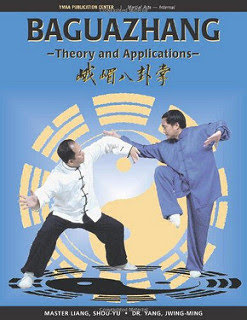
Baguazhang - Theory and Applications

YangJwingMing - Baguazhang Theory and Applcations
As far as a Martial Art goes, Bāguàzhăng (八卦掌) seems to me the least likely to be treated on a book format. The rich and varied traditions, styles and approaches make a pure programatic book - as the ones usually seen for Tàijíquán (太極拳) - look very partial. In particular for a beginner like me, it is difficult to identify what are the good entry points.
This book overcomes these difficulties. Even if the technical overview is related to Swimming Body Baguazhang, a specific tradition, the content is laid out in a way that the western beginner can follow. And as any book on martial arts, it has to be approached as a support for the practice. The main use I have for this book is as a reference. The chapters on The Essence of Baguazhang and Training Concepts are extremely useful to frame the instruction received in the regular practice. It is really a companion book for the Baguazhang beginner.