Friday, July 31, 2015

The Song of Eight Words in Taiji’s Engagement with the Opponent (太極人盤八字歌) by Yáng​ Bān​hóu​ (楊班侯)

太極人盤八字歌

八卦正隅八字歌,十三之數不幾何。
幾何若是無平準,丟了腰頂氣歎哦。
不斷妄言只而宇,君臣骨肉細琢磨。
功夫內外均不斷,對待數兒豈錯他。
對行於人出自然,由茲往復於地天。
但求捨己無深病,上下進退永連綿。

楊班侯
"The eight trigrams, sides and corners, are the song of the eight words; the number thirteen, after all, is not too large.
It becomes complex if there is no balance and precision; the waist, the push upwards and the breathing will be lost, only to be lamented.
The saying on uninterrupted movement contains only two words; one shall refine the relations between the sovereign and the minister, the muscles and bones.
If in Gongfu the internal and external are uniform and uninterrupted all not broken, one cannot be wrong in sparring. The right answer to the opponent is to go out naturally; to follow him back and forth like heaven and earth.
Only seek to give up oneself without defects; the top and the bottom, advance and retreat, can be executed continuously forever."

Based on the translation by Yang Jwing Ming (楊俊敏) presented in the book Tai Chi Secrets of the Yang Style (太極拳楊氏先哲秘要)

Friday, July 17, 2015

Straighten the Nape; Lift the Crown. Buttocks Slip; Hold the Anus (順項提頂,溜臀收肛) from The Real Theory of Baguazhang (八卦掌真理篇) by Jiāng Róngqiáo (薑容樵)

順項提頂,溜臀收肛

順項是使頸項自然豎直,在鍛煉時不要仰頭,不要低頭,也不要左右歪斜。提頂是將下頦裡收,頭向上直頂。溜臀是將臀部下垂向裡收縮,在鍛煉時不要有絲毫的向後撅臀的現象產生。收肛是將肛門的肌肉予以收縮控制,不要使它放鬆。

薑容樵
"Straighten the nape means the neck becomes naturally upright; during the practice one should not raise or bow the head nor incline it left or right. To lift of the crown means the chin is collected in; the head pushes up and straighten the crown of the head. Buttocks slip means the buttocks will hang down and contract inward. During the practice one should not let the buttocks even to start to stick out backwards. To hold the anus means one must apply a controlled contraction to the rectal muscle; and not allow it to loosen."

From the book Bāguàzhăng Practice Method (八卦掌練習法), by Jiāng Róngqiáo (薑容樵), based on the translation by Joseph Crandall

Friday, July 10, 2015

Taiji Above and Below explained as Heaven and Earth (太極上下名天地) by Yáng​ Bān​hóu​ (楊班侯)

太極進退不已功

四手上下分天地,採列肘靠有由去。
採天靠地相應求,何患上下不既濟!
若使挒肘習遠離,迷了乾坤遺歎惜。
此說亦明天地盤,進用肘挒歸人字。

楊班侯
"Differentiating the four hands above below are like heaven and earth; pluck, split, elbow and bump have their source in this separation.
If pluck from heaven and bump from earth correspond and look for each other; one should not worry if above and below support each other!
If one creates the habit of using split and elbow separately, one will lament the unbalance between heaven and earth.
This also explains the circles of heaven and earth; to advance in the application of split and elbow one should return to the word “man”."

Based on the translation by Yang Jwing Ming (楊俊敏) presented in the book Tai Chi Secrets of the Yang Style (太極拳楊氏先哲秘要)

Friday, June 26, 2015

Thirty-sixth Secret Song (歌訣三十六) from the The Thirty-Six Songs of Baguazhang (八卦掌三十六歌) Trigésima Sexta Canção Secreta (歌訣三十六) das Trinta e Seis Canções do Bāguàzhăng (八卦掌三十六歌)

歌訣三十六

用時最要是精神,
精神煥發耳目真,
任憑他人飛燕手,
蟻鳴我聽虎龍吟。

"When in application the key is vitality.
When one is glowing with health and vigor, all senses are alert.
It does not matter if the opponent’s hands are fast like a flying swallow,
The shout of an ant is like a tiger’s roaring or a dragon hissing to my ears."

Based on the translations by Yang Jwing Ming (楊俊敏) and Liang Shou You (梁守渝) in "Baguazhang - Theory and Applications" (峨嵋八卦掌) and by Frank Allen and Tina Chunna Zhang in "The Whirling Circles of Ba Gua Zhang"

Friday, June 19, 2015

Upright (正) from Foundation (基礎)Centro (中) de Fundamentos (基礎)

正

正者,姿勢端正。每一姿勢,務宜端正,而忌偏斜。然各種姿勢,各不相同,或仰,或俯,或伸,或屈,非盡中正。是以其發勁,及其用意之方向,而求其重心。蓋重心為全體樞紐。重心立,則開合靈活自如,重心不立,則開合失其關鍵。如車軸為車輪之樞紐,若使車軸置於偏斜,而不适於車身之重心處,則車輪轉動,進退失其效用矣。故拳架之姿勢,務求正确,則重心平穩,要不自牽扯其重心,而辨別虛實也。
"Upright means that the postures are correct. It means that every posture should be appropriate and upright, no posture should be given up and slant. Differente types of postures exist that have nothing in common with each other, they face upward, look down, extend, bend, at the end not centered and upright. The emission of Jin and the direction of the intention request the weight center. This is because the weight center is the main hinge of the entire body. Once the weight center is established, then opening and closing are nimble and unconstrained; if it is not established, opening and closing will miss its pivotal point. It is like the axle, who is the major hinge of the wheel; if it is out of alignement and not located at the weight center of the car, then the wheels with turn back and forth without being effective. This is why the frame of the boxing is the posture, it is important that it is correct so the weight center is steady; otherwise the weight center will be shifted and it will be impossible to differentiate the insubstantial and the substantial."

By Wú Gōngzǎo (吳公藻), based on the translation by by Yang Jwing Ming (楊俊敏) presented in the book Tai Chi Secrets of the Wu Style (太極拳吳氏先哲秘要).
""

De Wú Gōngzǎo (吳公藻), baseado na tradução de Yang Jwing Ming (楊俊敏) apresentada no livro Tai Chi Secrets of the Wu Style (太極拳吳氏先哲秘要).

Friday, June 12, 2015

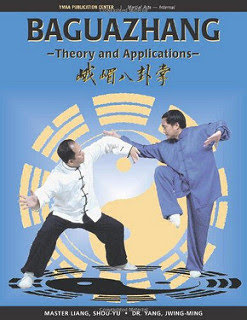
Baguazhang - Theory and Applications

YangJwingMing - Baguazhang Theory and Applcations
As far as a Martial Art goes, Bāguàzhăng (八卦掌) seems to me the least likely to be treated on a book format. The rich and varied traditions, styles and approaches make a pure programatic book - as the ones usually seen for Tàijíquán (太極拳) - look very partial. In particular for a beginner like me, it is difficult to identify what are the good entry points.
This book overcomes these difficulties. Even if the technical overview is related to Swimming Body Baguazhang, a specific tradition, the content is laid out in a way that the western beginner can follow. And as any book on martial arts, it has to be approached as a support for the practice. The main use I have for this book is as a reference. The chapters on The Essence of Baguazhang and Training Concepts are extremely useful to frame the instruction received in the regular practice. It is really a companion book for the Baguazhang beginner.

Wednesday, June 10, 2015

Excerpt from Man in the World, Associated with other Men (人間世) in Zhuāng zi (莊子)

山木自寇也,膏火自煎也。桂可食,故伐之;漆可用,故割之。人皆知有用之用,而莫知無用之用也。

莊子
"The mountain by its trees weakens itself. The grease which ministers to the fire fries itself. The cinnamon tree can be eaten, and therefore it is cut down. The varnish tree is useful, and therefore incisions are made in it. All men know the advantage of being useful, but no one knows the advantage of being useless. "

Unless noted otherwise, all quotations of classical texts and accompanying translations come from the Chinese Text Project

Friday, June 5, 2015

Taiji Endless Workings of Advancing and Retreating (太極進退不已功) by Yáng​ Bān​hóu​ (楊班侯)

太極進退不已功

掤進捋退自然理,
陰陽水火相既濟。
先知四手得來真,
採捌肘靠方可許。
四隅從此演出來,
十三勢架永無已。
所以因之名長拳,
任君開展與收斂,
千萬不可離太極。

楊班侯
"That Peng advances and Lu retreats is the natural order,
As Yin and Yang, water and fire support each other.
First reach a genuine understanding of the four hands,
Then can the directions of Cai, Lie, Zhou and Kao be allowed.
Once the four cornes can be performed,
The thirteen postures go on without an end.
This is the reason for calling it Long Fist,
It allows one to master how to start and finish,
By all means one should not part from Tai Chi."

Based on the translation by Yang Jwing Ming (楊俊敏) presented in the book Tai Chi Secrets of the Yang Style (太極拳楊氏先哲秘要)