"The grand polarity, as a sword posture, arises from nonpolarity and gives rise to the trigrams of Qian and Kun. Leftward circle walking corresponds to Qian. Rightward circle walking corresponds to Kun. The spinning of the sword is a continuous flow inside. To make an image of this principle: an empty circle. From an empty circle arises a divided circle. Within this divided circle, movement is generated by the extreme of stillness. People call it “truth”. Elixirists call it “innateness”. The authentic active aspect when it is continuous is the “sword of wisdom”. In Xingyi Boxing, it would be considered the innate shapelessness of the crossing technique. In Bagua Sword, it is called “grand polarity”. In this posture, at the beginning of the movement, although internally there is the theory of Qian and Kun, there is not yet such a shape externally, and so it is called the GRAND POLARITY POSTURE. It is like during seated meditation when mind enters void. This initial movement with the sword produces all that follows. Therefore with this posture it is not necessary to use another kind of internal energy. The standard for the sword movements is always the same as the ways of internal boxing arts and elixirism. The Elixir Book says: “The ‘wisdom sword’ can take away the body’s demons. The ‘precious sword’ can ward away the world’s evils."
Saturday, June 22, 2019
Saturday, June 15, 2019
The Study of Taiji in the Sword (太極劍學) from the Study of Bagua Sword (八卦劍學)
太極劍學
太極者劍之形式也無極而生乾坤之母左轉之而為乾像右旋之而為坤形劍之旋轉是內中一氣之 流行也此理是一字而生這○自這○而又生Ф也這Ф當中之一竪是由靜極而生動在人謂之眞意在丹道謂之先天眞陽一氣為慧劍在形意拳中謂之先天無形之橫拳在八卦劍 中謂之太極此式初動內雖有乾坤之理外未具乾坤之象所以謂之太極劍也譬諸坐功由神氣定住再垂簾塞兌回光觀玄之時此時劍之初動是萬物之母是以此劍不必格外再用 內功之氣劍之動作規矩法則無不是內家拳術之道與丹道學之理丹書云慧劍可以消身內之魔寳劍可以辟世上之邪。
太極者劍之形式也無極而生乾坤之母左轉之而為乾像右旋之而為坤形劍之旋轉是內中一氣之 流行也此理是一字而生這○自這○而又生Ф也這Ф當中之一竪是由靜極而生動在人謂之眞意在丹道謂之先天眞陽一氣為慧劍在形意拳中謂之先天無形之橫拳在八卦劍 中謂之太極此式初動內雖有乾坤之理外未具乾坤之象所以謂之太極劍也譬諸坐功由神氣定住再垂簾塞兌回光觀玄之時此時劍之初動是萬物之母是以此劍不必格外再用 內功之氣劍之動作規矩法則無不是內家拳術之道與丹道學之理丹書云慧劍可以消身內之魔寳劍可以辟世上之邪。
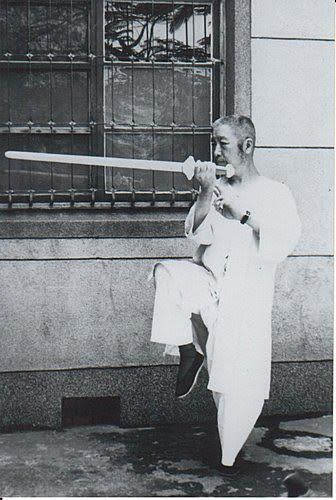
起點先將腰塌勁頭往上頂住勁兩肩往下垂着勁舌頂上腭口似張非張似脗非脗鼻孔出氣呼吸要 自然不可着意兩足亦往上蹬勁諸處之勁皆是自然用意不要用拙力再將左手大拇指與二指中指伸直無名指與小指用力屈回稍節與中節根節直着與中指相倂五指屈伸用力 要均匀左手之式並非與他劍揑訣相同取其五指屈伸左手不必格外用力此式能助右手之劍屈伸往來變化之力亦並非一定不易之規矩有時亦可五指俱伸因劍之形式而定學 者不可膠執再將右足往裏扭直與左足成為四十五度之式兩手自中陰中陽皆與右足往裏扭時亦同時往外扭扭至兩手皆至太陰式停住兩胳膊仍靠着身子再將兩腿徐徐曲下 兩腿裏曲不可有死灣子如圖是也右手之劍亦與兩腿下曲時同時胳膊靠着右脇劍尖往着左足尖前平着伸去與左足尖前邊成一交會線手仍是太陰劍把劍尖與心口平左手亦 於劍動時手太陰着同時胳膊靠着左脇往右胳膊肘後下邊穿去手背挨着右胳膊左胳膊靠着心口兩眼望着劍尖看去將神氣定住頭頂兩肩下垂有往回縮之意皆是自然不可用 拙力方可得着中和之氣而注於丹田也。
"To begin, first get your waist to have an energy of sinking, your head to have an energy of pressing up, your shoulders to have an energy of hanging down. Your tongue touches your upper palate, your mouth is flat but not flat, pursed but not pursed. The breath is through your nose. The breathing should be natural and must not be concentrated upon. Your feet have an energy of pressing up. Everywhere the strength is natural, for you should use intention rather than awkward exertion. Then your left thumb, forefinger, and middle finger extend, while the ring finger and little finger forcefully bend inward from the middle knuckle, the section from root knuckle to middle knuckle lined up next to the middle finger. The fingers use the same degree of strength whether bending or extending. Your left hand’s posture is not really the same as the pinched swordsman’s hex of other sword sets. When your fingers bend and extend, your left hand does not need to use extra force. Its posture can assist the power of the sword’s bending and extending, coming and going, and transforming, rather than being a fixed and unchanging shape, for sometimes all five fingers can be extended, in accordance with the sword posture, and so you must not be obsessed with grasping. Then your right foot twists inward to point straight, making a forty-five degree angle with your left foot. As your right foot twists inward, your hands twist outward from their half passive positions until they are each in a full passive position, your arms still close to your body. Then your legs slowly bend downward, though it must not be a dead bend. It is like the photo. As your legs bend down, and with your right arm close to your right ribs, the sword extends with a flat blade in front of you and in line with your left toes, the hand still in its full passive position. The sword handle and sword tip are at solar plexus level. During the movement, your left hand, also still in its full passive position, is close to your left ribs and threads under and behind your right elbow, the back of the hand close to your right arm, the arm close to your solar plexus. Your gaze is toward the sword tip. Your spirit and energy stay stable. Your head presses up, but your shoulders drop down and have an intention of shrinking in. Everything should be natural and there must be no use of awkward exertion. Then you can have an energy of centered harmoniousness and concentrate it into your elixir field."
Translation by Paul Brennan of "Study of Bagua Sword" (八卦劍學) by Sūn Lùtáng (孫祿堂), to be found in the Brennan Translation blog.
Translation by Paul Brennan of "Study of Bagua Sword" (八卦劍學) by Sūn Lùtáng (孫祿堂), to be found in the Brennan Translation blog.
Friday, May 3, 2019
Thursday, January 10, 2019
Sitting Alone at Mount Jingting (獨坐敬亭山) by Lǐ Bái (李白)
獨坐敬亭山
衆鳥高飛盡
孤雲獨去閒
相看兩不厭
只有敬亭山
衆鳥高飛盡
孤雲獨去閒
相看兩不厭
只有敬亭山
"Vanished are the birds upon soaring high,
Save a cloud solitary, floats freely by.
Tired not of reciprocating one another's gaze,
Thou, and thou only, Mount Jingting and I."
Translated by Andrew W.F. Wong (Huang Hongfa) 譯者: 黃宏發
Save a cloud solitary, floats freely by.
Tired not of reciprocating one another's gaze,
Thou, and thou only, Mount Jingting and I."
Translated by Andrew W.F. Wong (Huang Hongfa) 譯者: 黃宏發
Tuesday, January 1, 2019
Monday, December 31, 2018
Sunday, December 30, 2018
Saturday, December 29, 2018
Thursday, December 27, 2018
Friday, December 21, 2018
Sunday, December 16, 2018
Saturday, December 15, 2018
Friday, December 14, 2018
Wednesday, November 14, 2018

Friday, October 5, 2018
A Detailed Look at the Theories of Xingyi, Bagua and Taichi (詳論形意八卦太極之原理) - Continuation and End
太極拳發明於張三丰祖師。盡人知之。惟練此拳之起點。當先求一個不偏不倚。不上不下。至簡至易之道。拳經云。抱元守一。而虛中。虛空而念化。實其腹而道心生。卽此意也。太極從無極而生。為無極之後天。萬極之先天。承上啓下。能與天地合德。日月合明。四時合序。與鬼神合其吉凶。練之到至善處。以和為體。和之中智勇生焉。極未動時。為未發之和。極已動時。為已發之中。所以拳術一道。首重中和。中和之外。無元妙也。故太極拳。要純任自然。不尚血氣。以蓄神為主。周身輕靈〔。不卽不離。勿妄勿助。內天德而外王道。〕將起點之極。逐漸推之。貫於周身。無微不至。易曰。黄中通理。正位居體。卽此意也。昔年曾聞之師云。此起點之極。與丹道中之元關相同。鄙人研究數十年。不敢云確有心得。然考其本源。實與形意八卦。其理相通。不過名稱與形式之動作不同耳。至若善養氣練神。則初無少異。譬之形意。地也。八卦天也。太極人也。天地人三才。合為一體。混然一氣。實無區分。練之久。而動靜〔自如。頭頭是道。又何形意。八卦。太極之〕有哉。至峨眉派。傳之梅花八式。志公禪師亦重氣養之功。兹不必更贅也。
"Taiji Boxing was invented by Zhang Sanfeng, as everyone knows. At the beginning of practicing this art, you should first seek for the method of “neither leaning nor inclining, neither rising nor falling, acting with absolute simplicity and absolute ease”. A boxing text says [paraphrasing from the kestrel section in his own Xingyi manual]: “By embracing primal oneness, there is emptiness. With emptiness, there is transformation. Then with fullness in the abdomen, the Daoist mind is born.” It is this idea.
Taiji [“grand polarity”] comes from wuji [“nonpolarity”]. It is nonpolarity’s acquired state and the innate quality of all things, and thus the transition from nothing to everything, [again from his Xingyi manual:] “just as the sky and ground combine to make virtue, the sun and moon combine to make illumination, the four seasons combine to make the cycle of the seasons, and ghosts and spirits combine to make the foretelling of good or bad fortune.” If you practice it to a high level, harmoniousness will manifest, then from within harmoniousness, wisdom and courage will arise. Right before taking any action, there is the harmoniousness of not yet expressing. Once action is taken, there is the centeredness of having expressed.
Therefore the way of this boxing art most of all emphasizes centered harmoniousness. Without this centered harmoniousness, there would be nothing wonderful about it. Thus Taiji Boxing seeks to be purely natural and puts no value on vigor. It aims to store up spirit, making the whole body nimble, so that there is neither reaching nor separating, neither rashness nor rescuing, internally the virtue of Nature and externally the way of kings.
Right from the start, gradually work at it until a centered harmoniousness fills your whole body, reaching even to the smallest part. It says in the Book of Changes [hexagram 2 explanation]: “The gentleman takes yellow [the color associated with the center, i.e. centeredness] as his guiding principle, which corrects his behavior and affects his very being. [The beauty within this condition reaches to his extremities, making everything he does sublime.]” This is the idea.
My teacher [Hao Weizhen] once told me: “Right from the start, this art is the same as the ‘primal gateway’ of the elixirists.” I have been studying this art for several decades, but I would not dare to say that I have a true grasp of it. However, when considering its origins, it is truly interconnected with Xingyi and Bagua in terms of theory. It is only different in its movements and the names of its postures, while as for its qualities of nurturing energy and developing spirit, there is not the slightest difference.
By analogy, Xingyi is the ground, Bagua is the sky, and Taiji is mankind. The three substances of sky, ground, and mankind are merged into a single whole, mixed into a union with no meaningful distinctions. After practicing for a long time, there is fluency in both movement and stillness, and clarity as to the reasoning of the method. Ah, what a thing it is to have Xingyi, Bagua, and Taiji! As for the Emei school’s transmission of the Eight-Posture Plum Blossoms art, as well as Zen master Bai Zhi’s breathing exercises, it is not necessary to go into them here."
Translation by Paul Brennan of "A Detailed Look at the Theories of Xingyi, Bagua and Taichi" (詳論形意八卦太極之原理) by Sūn Lùtáng (孫祿堂), to be found in the Brennan Translation blog.
Taiji [“grand polarity”] comes from wuji [“nonpolarity”]. It is nonpolarity’s acquired state and the innate quality of all things, and thus the transition from nothing to everything, [again from his Xingyi manual:] “just as the sky and ground combine to make virtue, the sun and moon combine to make illumination, the four seasons combine to make the cycle of the seasons, and ghosts and spirits combine to make the foretelling of good or bad fortune.” If you practice it to a high level, harmoniousness will manifest, then from within harmoniousness, wisdom and courage will arise. Right before taking any action, there is the harmoniousness of not yet expressing. Once action is taken, there is the centeredness of having expressed.
Therefore the way of this boxing art most of all emphasizes centered harmoniousness. Without this centered harmoniousness, there would be nothing wonderful about it. Thus Taiji Boxing seeks to be purely natural and puts no value on vigor. It aims to store up spirit, making the whole body nimble, so that there is neither reaching nor separating, neither rashness nor rescuing, internally the virtue of Nature and externally the way of kings.
Right from the start, gradually work at it until a centered harmoniousness fills your whole body, reaching even to the smallest part. It says in the Book of Changes [hexagram 2 explanation]: “The gentleman takes yellow [the color associated with the center, i.e. centeredness] as his guiding principle, which corrects his behavior and affects his very being. [The beauty within this condition reaches to his extremities, making everything he does sublime.]” This is the idea.
My teacher [Hao Weizhen] once told me: “Right from the start, this art is the same as the ‘primal gateway’ of the elixirists.” I have been studying this art for several decades, but I would not dare to say that I have a true grasp of it. However, when considering its origins, it is truly interconnected with Xingyi and Bagua in terms of theory. It is only different in its movements and the names of its postures, while as for its qualities of nurturing energy and developing spirit, there is not the slightest difference.
By analogy, Xingyi is the ground, Bagua is the sky, and Taiji is mankind. The three substances of sky, ground, and mankind are merged into a single whole, mixed into a union with no meaningful distinctions. After practicing for a long time, there is fluency in both movement and stillness, and clarity as to the reasoning of the method. Ah, what a thing it is to have Xingyi, Bagua, and Taiji! As for the Emei school’s transmission of the Eight-Posture Plum Blossoms art, as well as Zen master Bai Zhi’s breathing exercises, it is not necessary to go into them here."
Translation by Paul Brennan of "A Detailed Look at the Theories of Xingyi, Bagua and Taichi" (詳論形意八卦太極之原理) by Sūn Lùtáng (孫祿堂), to be found in the Brennan Translation blog.
Friday, September 28, 2018
A Detailed Look at the Theories of Xingyi, Bagua and Taichi (詳論形意八卦太極之原理) - Continuation
八卦拳始於有淸咸同之季。直隸文海董海川先生。漫遊南省。於皖屬渝花山。得異人之傳。謂之八卦者。由無極而太極。太極生兩儀。兩儀生四象。四象生八卦。參互錯綜。拳卽運用八卦之理。何以言之。今腹為無極。臍為太極。腎為兩儀。兩臂膊與腿為四象。其生八卦者。兩臂與腿。曲之為八節。共生八八六十四卦者。兩手十指。每指三節。惟大拇係兩節。八卦共二十四節。加兩拇指四節。得二十八節。加兩足念八節。為五十六。又加兩臂兩腿之八節。為六十四節。故六十四卦,為拳之體。體為三百六十四爻。則互為其用也。每爻有每爻之意。陽極〔而陰。陰極而陽。逆中行順。順中用逆。求〕其中和。氣歸丹田。含有靜極而動。動極而靜之意。上下相通。是為內呼吸。此拳與道家工夫。相為表裏。不特此也。乾坤坎離。等卦。或為龍。或為馬。或為牛。皆取象于物。心在內。而理周於物。物在外。而理具於心。近取諸身。遠取諸物。奇正變化。運用不窮。而又剛柔相濟。虛實兼到。空而不空。不空而空。此八卦拳之妙用也。
"Bagua Boxing began during the reigns of Emperors Xianfeng [1850-1861] and Tongzhi [1861-1875]. Dong Haichuan of Wenhai, Hebei, was roaming through the southern provinces. At Mt. Yuhua in Anhui he was taught by an extraordinary man an art called Bagua [“eight trigrams”], as in [from the Book of Changes, Great Treatise, part 1:] “Nonpolarity generated the grand polarity, the grand polarity generated the dual aspects, the dual aspects generated the four manifestations, and the four manifestations generated the eight trigrams.” The eight then mix together intricately. The boxing art is the theory of the utilizing of the eight trigrams. What does this mean?
The abdomen represents nonpolarity. The navel is the grand polarity. The kidneys are the dual aspects. The arms and legs are the four manifestations. They generate the eight trigrams by way of the two joints of each limb [i.e. elbow/knee, wrist/ankle]. To then multiply this eight by eight and make sixty-four: the ten fingers each have three joints, except for the thumbs, which have only two, and this totals an additional twenty-four, then adding the four joints of the thumbs brings the additional total up to twenty-eight, then adding the same [twenty-eight] joints from [all of the toes of the] feet brings the additional total up to fifty-six, then with the initial eight limb-joints this makes sixty-four joints. The sixty-four hexagrams in this way make the basis of the boxing art.
Then the three hundred sixty-four [three hundred eighty-four] lines of the hexagrams [each hexagram of course having six lines] interact to produce effects. There is an intention of every line having the potential to become the other type of line [active lines (called “nines”) able to become passive lines (called “sixes”) and vice versa]. When the active aspect reaches its peak, there is the passive. When the passive aspect reaches its peak, there is the active. Within going against, there is the action of going along, and within going along, there is the function of going against.
Seek for a state of centered harmoniousness, energy returning to your elixir field. Contained within this is the idea that when stillness reaches its peak, there is movement, and when movement reaches its peak, there is stillness. This up and down switching of states [in the way that the trigrams composing a hexagram can be flipped above and below to produce a new hexagram] is called “internal breathing”.
This boxing art is interrelated with Daoist practices not only in this way. The trigrams are also each associated with animals, for instance the dragon [associated with the Zhen trigram], horse [Qian trigram], cow [Kun trigram], and so on, all represented by animals. “The mind is internal, yet its reasoning extends to all things. Things are external, yet their principles are all there in the mind.” “For what is near, examine within the self. For what is distant, observe all things.” There is limitless alternating between direct and indirect techniques. There is also hardness and softness assisting each other so that emptiness and fullness are mutually achieved, and you can be empty but not empty, not empty and yet empty. Such are the subtleties of Bagua Boxing."
Translation by Paul Brennan of "A Detailed Look at the Theories of Xingyi, Bagua and Taichi" (詳論形意八卦太極之原理) by Sūn Lùtáng (孫祿堂), to be found in the Brennan Translation blog.
The abdomen represents nonpolarity. The navel is the grand polarity. The kidneys are the dual aspects. The arms and legs are the four manifestations. They generate the eight trigrams by way of the two joints of each limb [i.e. elbow/knee, wrist/ankle]. To then multiply this eight by eight and make sixty-four: the ten fingers each have three joints, except for the thumbs, which have only two, and this totals an additional twenty-four, then adding the four joints of the thumbs brings the additional total up to twenty-eight, then adding the same [twenty-eight] joints from [all of the toes of the] feet brings the additional total up to fifty-six, then with the initial eight limb-joints this makes sixty-four joints. The sixty-four hexagrams in this way make the basis of the boxing art.
Then the three hundred sixty-four [three hundred eighty-four] lines of the hexagrams [each hexagram of course having six lines] interact to produce effects. There is an intention of every line having the potential to become the other type of line [active lines (called “nines”) able to become passive lines (called “sixes”) and vice versa]. When the active aspect reaches its peak, there is the passive. When the passive aspect reaches its peak, there is the active. Within going against, there is the action of going along, and within going along, there is the function of going against.
Seek for a state of centered harmoniousness, energy returning to your elixir field. Contained within this is the idea that when stillness reaches its peak, there is movement, and when movement reaches its peak, there is stillness. This up and down switching of states [in the way that the trigrams composing a hexagram can be flipped above and below to produce a new hexagram] is called “internal breathing”.
This boxing art is interrelated with Daoist practices not only in this way. The trigrams are also each associated with animals, for instance the dragon [associated with the Zhen trigram], horse [Qian trigram], cow [Kun trigram], and so on, all represented by animals. “The mind is internal, yet its reasoning extends to all things. Things are external, yet their principles are all there in the mind.” “For what is near, examine within the self. For what is distant, observe all things.” There is limitless alternating between direct and indirect techniques. There is also hardness and softness assisting each other so that emptiness and fullness are mutually achieved, and you can be empty but not empty, not empty and yet empty. Such are the subtleties of Bagua Boxing."
Translation by Paul Brennan of "A Detailed Look at the Theories of Xingyi, Bagua and Taichi" (詳論形意八卦太極之原理) by Sūn Lùtáng (孫祿堂), to be found in the Brennan Translation blog.
Friday, September 21, 2018
A Detailed Look at the Theories of Xingyi, Bagua and Taichi (詳論形意八卦太極之原理)
詳論形意八卦太極之原理
拳術之犖犖大者。約分三派。一少林。二武當。三峨眉。其餘門類繁多。大半不出此三派之範圍,少林始於達摩之易筋、洗髓、兩經。至有宋岳武穆。始有形意拳之名。卽易筋之作用也。謂之形意。形卽形式。意卽心意。由心之所發。而以手足形容也。其拳有五綱十二目。五綱者。金、木、水、火、土,五行也。而拳中、有劈、崩、躦、炮、横、之五拳。十二目者。卽十二形也。有龍、虎、猴、馬、鼍、鷄、鷂、鴿、燕、蛇、鷹、熊、是也。其取此十二形者。卽取性能。而又能包括一切。所謂盡人之性。則能盡物之性。何以知其然也。劈拳屬金。在人〔屬肺。崩拳屬木。在人屬肝。鑽拳屬水。在〕人屬腎。炮拳屬火。在人屬心。横拳屬土。在人屬脾。練之旣久。可以袪五臟之病。此謂居人之性也。至若龍有搜骨之法。虎有撲食之猛。猴有縱山之靈,熊有浮水之性。推之其他八形。各有其妙。此所謂居物之性也。人物之性旣居。起落進退。變化無窮。是其智也。得中和。體物不遺。是其仁也。心與意合。意與氣合。氣與力合。為內三合。肩與胯合。肘與膝合。手與足合。為外三合。內外如一。成為六合。是其勇也。三者旣備。動作運用。上下相連。手足相顧。至大至剛。養吾浩然之氣。與儒家誠中。形外之理。一以貫之。此形意拳之大槪也。
拳術之犖犖大者。約分三派。一少林。二武當。三峨眉。其餘門類繁多。大半不出此三派之範圍,少林始於達摩之易筋、洗髓、兩經。至有宋岳武穆。始有形意拳之名。卽易筋之作用也。謂之形意。形卽形式。意卽心意。由心之所發。而以手足形容也。其拳有五綱十二目。五綱者。金、木、水、火、土,五行也。而拳中、有劈、崩、躦、炮、横、之五拳。十二目者。卽十二形也。有龍、虎、猴、馬、鼍、鷄、鷂、鴿、燕、蛇、鷹、熊、是也。其取此十二形者。卽取性能。而又能包括一切。所謂盡人之性。則能盡物之性。何以知其然也。劈拳屬金。在人〔屬肺。崩拳屬木。在人屬肝。鑽拳屬水。在〕人屬腎。炮拳屬火。在人屬心。横拳屬土。在人屬脾。練之旣久。可以袪五臟之病。此謂居人之性也。至若龍有搜骨之法。虎有撲食之猛。猴有縱山之靈,熊有浮水之性。推之其他八形。各有其妙。此所謂居物之性也。人物之性旣居。起落進退。變化無窮。是其智也。得中和。體物不遺。是其仁也。心與意合。意與氣合。氣與力合。為內三合。肩與胯合。肘與膝合。手與足合。為外三合。內外如一。成為六合。是其勇也。三者旣備。動作運用。上下相連。手足相顧。至大至剛。養吾浩然之氣。與儒家誠中。形外之理。一以貫之。此形意拳之大槪也。
"The major boxing arts are generally divided into three schools: Shaolin, Wudang, and Emei. As for the rest, there is a great variety, but more than half can be classified under these schools. Shaolin began with Damo’s two classics – Sinew Changing and Marrow Washing. Then Yue Fei in the Song Dynasty started what was called Xingyi Boxing, applying his own Bone Changing Classic and calling his art Xingyi [“form” & “intent”]. “Form” means the shape. “Intent” means the mental intention. What is expressed from the mind manifests in the hands and feet.
This boxing art has “five cores” and “twelve imitations”. The five cores are the five elements – metal, wood, water, fire, earth – which make the five boxing techniques of chopping, crashing, drilling, blasting, and crossing. The twelve imitations are the twelve animals: dragon, tiger, monkey, horse, alligator, rooster, hawk, kestrel, swallow, snake, eagle, and bear. Strive for the instincts and abilities of these twelve animals, and to be able to incorporate within yourself everything they can do. Thus it is said [in the Zhong Yong]: “Giving full expression to human nature, one is thus able to give full expression to the nature of animals.”
What should we understand to be the nature of this art? The chopping technique corresponds to metal, and in the body to the lungs. The crashing technique corresponds to wood, and in the body to the liver. The drilling technique corresponds to water, and in the body to the kidneys. The blasting technique corresponds to fire, and in the body to the heart. The crossing technique corresponds to earth, and in the body to the spleen. After practicing for a long time, it can dispel the ailments of the five organs. This is called “ingraining human nature”.
As for the animals, the dragon has the method of shrinking its body, the tiger has the fierceness of pouncing on prey, the monkey has the nimbleness of bounding up hillsides, the bear [alligator] has the quality of floating on water, and the other eight animals each have their own ingenuities. This is called “ingraining the nature of animals”.
When both human and animal natures are ingrained, then lifting and dropping, advancing and retreating, transforming without limit, will all as a result be performed with resourcefulness.
Obtaining a state of centered harmoniousness, the essence of the animal does not get discarded and yet the result is humanity.
Mind is united with the intention, the intention united with the energy, and the energy united with the power. These are the three internal unions. The shoulder is united with the hip, the elbow united with the knee, and the hand united with the foot. These are the three external unions. The internal and external unions merged together makes the six unions, and the result is courage.
Once these three things [resourcefulness, humanity, courage] are prepared, then in every action and movement, upper body and lower will be coordinated with each other, hand and foot will be aligned with each other, and you will be [from Mengzi, chapter 2a:] “nurturing your noble energy… until it is vast and strong”. It is within the Confucian concept of sincerity that can be found the key to these external shapes, the [from the Lun Yu, 15.3:] “single principle running through the whole thing”. These are the main ideas of Xingyi Boxing."
Translation by Paul Brennan of "A Detailed Look at the Theories of Xingyi, Bagua and Taichi" (詳論形意八卦太極之原理) by Sūn Lùtáng (孫祿堂), to be found in the Brennan Translation blog.
This boxing art has “five cores” and “twelve imitations”. The five cores are the five elements – metal, wood, water, fire, earth – which make the five boxing techniques of chopping, crashing, drilling, blasting, and crossing. The twelve imitations are the twelve animals: dragon, tiger, monkey, horse, alligator, rooster, hawk, kestrel, swallow, snake, eagle, and bear. Strive for the instincts and abilities of these twelve animals, and to be able to incorporate within yourself everything they can do. Thus it is said [in the Zhong Yong]: “Giving full expression to human nature, one is thus able to give full expression to the nature of animals.”
What should we understand to be the nature of this art? The chopping technique corresponds to metal, and in the body to the lungs. The crashing technique corresponds to wood, and in the body to the liver. The drilling technique corresponds to water, and in the body to the kidneys. The blasting technique corresponds to fire, and in the body to the heart. The crossing technique corresponds to earth, and in the body to the spleen. After practicing for a long time, it can dispel the ailments of the five organs. This is called “ingraining human nature”.
As for the animals, the dragon has the method of shrinking its body, the tiger has the fierceness of pouncing on prey, the monkey has the nimbleness of bounding up hillsides, the bear [alligator] has the quality of floating on water, and the other eight animals each have their own ingenuities. This is called “ingraining the nature of animals”.
When both human and animal natures are ingrained, then lifting and dropping, advancing and retreating, transforming without limit, will all as a result be performed with resourcefulness.
Obtaining a state of centered harmoniousness, the essence of the animal does not get discarded and yet the result is humanity.
Mind is united with the intention, the intention united with the energy, and the energy united with the power. These are the three internal unions. The shoulder is united with the hip, the elbow united with the knee, and the hand united with the foot. These are the three external unions. The internal and external unions merged together makes the six unions, and the result is courage.
Once these three things [resourcefulness, humanity, courage] are prepared, then in every action and movement, upper body and lower will be coordinated with each other, hand and foot will be aligned with each other, and you will be [from Mengzi, chapter 2a:] “nurturing your noble energy… until it is vast and strong”. It is within the Confucian concept of sincerity that can be found the key to these external shapes, the [from the Lun Yu, 15.3:] “single principle running through the whole thing”. These are the main ideas of Xingyi Boxing."
Translation by Paul Brennan of "A Detailed Look at the Theories of Xingyi, Bagua and Taichi" (詳論形意八卦太極之原理) by Sūn Lùtáng (孫祿堂), to be found in the Brennan Translation blog.
Friday, August 10, 2018
Wednesday, August 8, 2018
Excerpt from the Harmony of Difference and Sameness (參同契)
當明中有暗
勿以暗相遇
當暗中有明
勿以明相睹
明暗各相對
比如前後歩
"In the light there is darkness,
but don't take it as darkness;
In the dark there is light,
but don't see it as light.
Light and dark oppose one another
like the front and back foot in walking."
By Shítóu Xīqiān, quoted from Sacred Texts
but don't take it as darkness;
In the dark there is light,
but don't see it as light.
Light and dark oppose one another
like the front and back foot in walking."
By Shítóu Xīqiān, quoted from Sacred Texts
Friday, August 3, 2018
The Proper Gate for the Eight Words Workout (正門八字功) attributed to Lǐ Cúnyì (李存義)
正門八字功
展:展者,寬之意,即拓張手足也。
截:截者,裁也,以裁退敵手也,此 節最見身法。
裹:裹者,圍裹也,裹 敵手使其失其效用也,身旋而力柔,有以柔克剛之妙。
跨:跨如跨馬之勢,是言其形也,實則托跨之勢。
挑:挑之力在肩与腿,与蛇形相类而手稍高。
頂:頂之力在頭,故此以挺頭垂肩為好。
雲:《說文》云,“從雨雲,象雲回轉之形”今所用者,即借其回轉之意,其兩掌皆如行云之飄忽焉。
領:領者,受也,順勢而領取也。
展:展者,寬之意,即拓張手足也。
截:截者,裁也,以裁退敵手也,此 節最見身法。
裹:裹者,圍裹也,裹 敵手使其失其效用也,身旋而力柔,有以柔克剛之妙。
跨:跨如跨馬之勢,是言其形也,實則托跨之勢。
挑:挑之力在肩与腿,与蛇形相类而手稍高。
頂:頂之力在頭,故此以挺頭垂肩為好。
雲:《說文》云,“從雨雲,象雲回轉之形”今所用者,即借其回轉之意,其兩掌皆如行云之飄忽焉。
領:領者,受也,順勢而領取也。
"Spread-out : To spread-out means a broad intention, to expand and open up hands and feet.
Intercept : To intercept also means to cut back. Use cut back to withdraw from the opponent, this saves most of what is visible in the posture.
Bind : To bind means to wrap all around the opponent so he loses his effectiveness. The body whirls in a circle and the power is soft. To use softness to conquer strength is clever.
Step across : Step across like one has the posture of straddling a horse, this is the shape meant by this words. In fact, to be supported with posture of the straddle.
Poke : The power of poking resides on the shoulder and the leg, together they are as if they were coiled and the hand is somewhat high.
Push Up : The power of pushing up resides at the head. Therefore an erect head and the hanging shoulders is the proper posture.
Cloud: the classics say, “when raining, the clouds appear to have a rotating shape”, today we employ this idea of rotation to mean both palms of the hand move swiftly like a cloud.
Receive: To receive means to bear, to seize an opportunity and obtain it.
"
Intercept : To intercept also means to cut back. Use cut back to withdraw from the opponent, this saves most of what is visible in the posture.
Bind : To bind means to wrap all around the opponent so he loses his effectiveness. The body whirls in a circle and the power is soft. To use softness to conquer strength is clever.
Step across : Step across like one has the posture of straddling a horse, this is the shape meant by this words. In fact, to be supported with posture of the straddle.
Poke : The power of poking resides on the shoulder and the leg, together they are as if they were coiled and the hand is somewhat high.
Push Up : The power of pushing up resides at the head. Therefore an erect head and the hanging shoulders is the proper posture.
Cloud: the classics say, “when raining, the clouds appear to have a rotating shape”, today we employ this idea of rotation to mean both palms of the hand move swiftly like a cloud.
Receive: To receive means to bear, to seize an opportunity and obtain it.
"
Subscribe to:
Posts (Atom)